
Interactive chemistry · General chemistry
Atomic Orbitals
See where the electron really is: a standing wave on a ring, a probability cloud built dot by dot, 3D s, p, d and f orbitals with nodes and phase, and electrons filling atoms up to krypton.
Open Atomic Orbitals ↗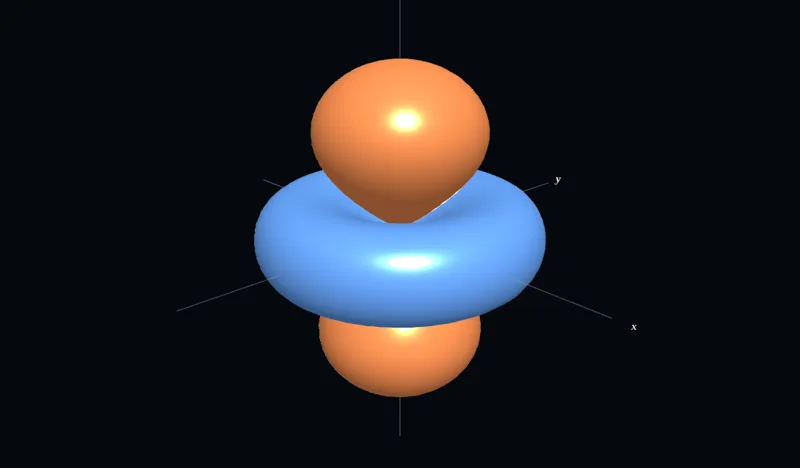
About this visualization
Seven parts: the electron as a wave, where only whole numbers of wavelengths fit around a ring; the 1s probability cloud built one measurement at a time, with the radial distribution peaking at 52.9 pm and a boundary surface you can set; any s, p, d or f orbital in 3D from n, l and m; nodes and phase on a moving cut through the orbital; size, penetration and Slater’s effective nuclear charge with NIST ionization energies; electrons filling atoms from hydrogen to krypton, with Pauli, Hund and the measured exceptions chromium and copper; and a practice bank of six question types with hints. Every orbital is computed from the hydrogen-atom wavefunction and checked by program. Key moments pause on the events that matter, and a History & Fun Facts drawer tells why the letters are s, p, d and f.
Numbers come from NIST-JANAF thermochemical tables and are checked by program: Kp = 0.149 at 298 K, 4.49 at 350 K and 51 at 400 K, ΔH° = 57.1 kJ/mol, and Kc = 54.3 for H₂ + I₂ ⇌ 2HI at 430 °C. Slowed time and other simplifications are stated in the Guide.
Explore other chemistry visualizations on the HexaMole resources page.