
Interactive chemistry · General chemistry
Chemical Bonding
Why atoms stick together: grab and pull atoms apart, watch H₂ form, see σ and π bonds, hybrids, hydrogen bonds and London forces, and build NaCl, MgO and sodium crystals ion by ion.
Open Chemical Bonding ↗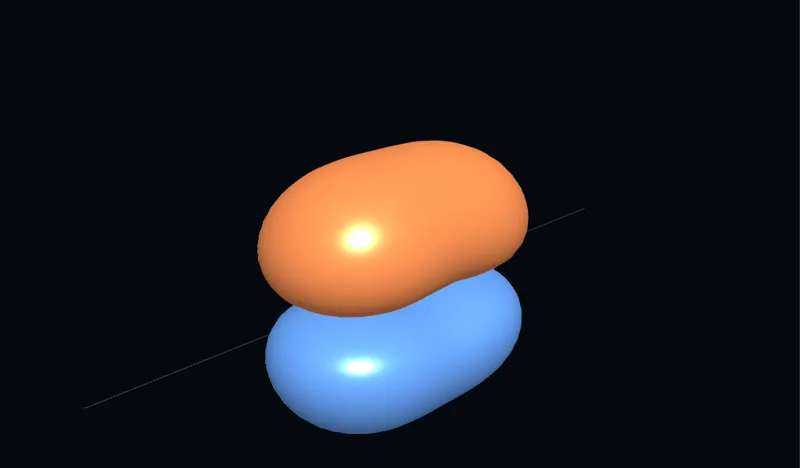
About this visualization
Ten parts: two H atoms approach and form H₂ (drag the atoms and feel attraction and repulsion); bonding and antibonding orbitals and bond order; σ and π bonds with the molecular orbital diagrams of Li₂ to Ne₂ and the magnetism of O₂; sp³, sp² and sp hybrids; polar bonds from H₂ to gaseous NaCl with dipole moments and percent ionic character; hydrogen bonds in water, where the second molecule turns, locks in and can be pulled away; London forces in the noble gases, with fluctuating electron clouds; ionic crystals of NaCl and MgO built ion by ion with their lattice energies; metallic bonding as sodium atoms build a body-centred cubic crystal and their levels merge into a band; and a practice bank of nine question types with hints. Energies come from measured spectroscopic constants and are checked by program. Key moments pause on the events that matter, and a History & Fun Facts drawer tells the stories of Lewis, Pauling, Mulliken, London and others.
Numbers come from NIST-JANAF thermochemical tables and are checked by program: Kp = 0.149 at 298 K, 4.49 at 350 K and 51 at 400 K, ΔH° = 57.1 kJ/mol, and Kc = 54.3 for H₂ + I₂ ⇌ 2HI at 430 °C. Slowed time and other simplifications are stated in the Guide.
Explore other chemistry visualizations on the HexaMole resources page.