
Interactive chemistry · Spectroscopy
Nature of Light
Light as a wave and as photons: polarizers, single photons building double-slit fringes, blackbody radiation, the photoelectric effect, brightness versus colour, and what each part of the spectrum does to matter.
Open Nature of Light ↗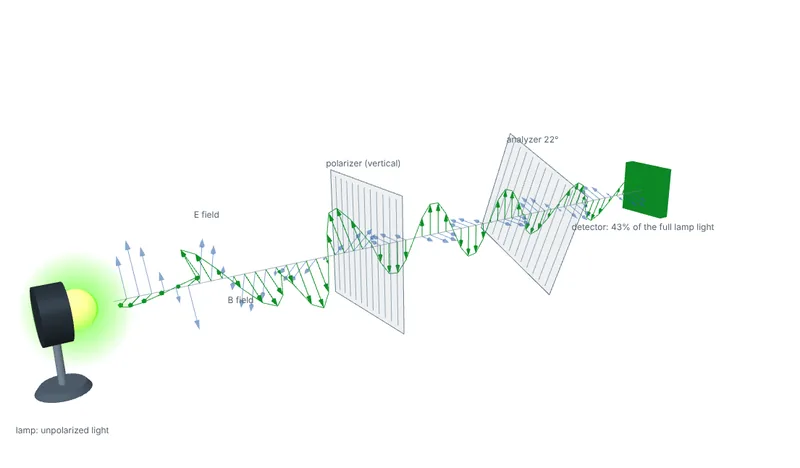
About this visualization
Seven parts: the wave, with its electric and magnetic fields, polarizers and light slowing in water and glass; the double slit, built up one photon at a time, with a which-slit detector; blackbody radiation from body temperature to the Sun, with an infrared-camera view; the photoelectric effect on six real metals, with the photon energy and the electron’s kinetic energy shown; brightness versus colour, where Cl₂ and H₂ show the two conditions for breaking a bond with light; the whole spectrum from radio waves to gamma rays and what each region does to matter, including Skoog’s three kinds of electronic transitions; and practice questions. Every number is computed from exact SI constants or cited data (Michaelson’s work functions, Planck’s law, worked values from OpenStax and Harris). Key moments pause on the events that matter, and a History & Fun Facts drawer tells the stories of Thomas Young, Max Planck, Robert Millikan and Albert Einstein.
Numbers are computed from exact SI constants and checked by program: sodium’s 589 nm line is 5.09 × 10¹⁴ Hz, a tungsten filament at 2870 K peaks at 1010 nm (Wien’s law), and sodium’s photoelectric threshold is 451 nm (work function 2.75 eV, Michaelson 1977). Slowed time and other simplifications are stated in the Guide.
Explore other chemistry visualizations on the HexaMole resources page.