
Interactive chemistry · Spectroscopy
Inside the UV-Vis Spectrophotometer
Follow light through a UV-Vis instrument: the lamps, a grating or prism splitting the colours (with a close-up of how), the monochromator slit, why Beer’s law bends, double-beam design, and ten real samples to scan.
Open Inside the UV-Vis Spectrophotometer ↗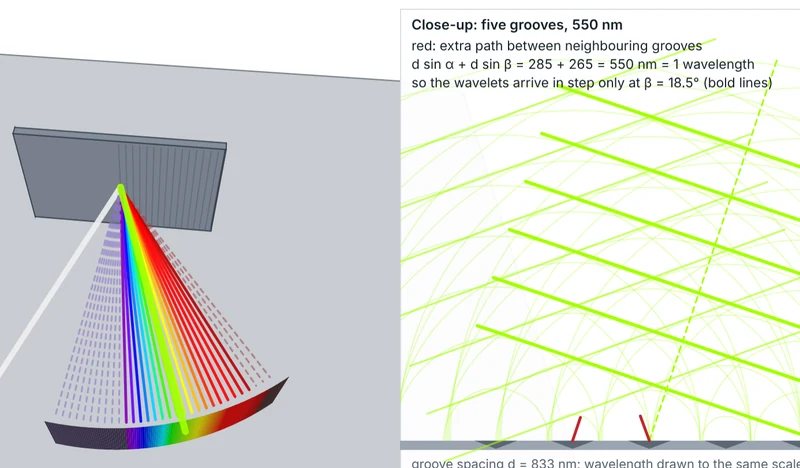
About this visualization
Seven parts: deuterium and tungsten-halogen sources with Planck and Wien; a grating or prism spreading the light, with the ultraviolet and infrared shown as invisible and a close-up of interference at the grooves and refraction in glass; a Czerny–Turner monochromator where slit width sets bandpass and throughput; stray light and finite bandwidth bending Beer’s law; double-beam design, detectors and shot noise; ten samples to scan or measure at one wavelength; and a practice bank of nine question types.
Numbers are checked against published worked examples and data: grating dispersion examples, Sellmeier refractive indices for fused silica (Malitson 1965) and BK7 (Schott), certified holmium oxide band positions, and published λmax and molar absorptivities for the samples. Illustrative parts, such as band widths and lamp drift, are labelled in the Guide.
Explore other chemistry visualizations on the HexaMole resources page.