
Interactive chemistry · Spectroscopy
Atomic Absorption Spectroscopy
How an AAS works: a realistic hollow-cathode lamp with an element picker, a slot-burner flame, a cut-away graphite furnace, interferences and background correction.
Open Atomic Absorption Spectroscopy ↗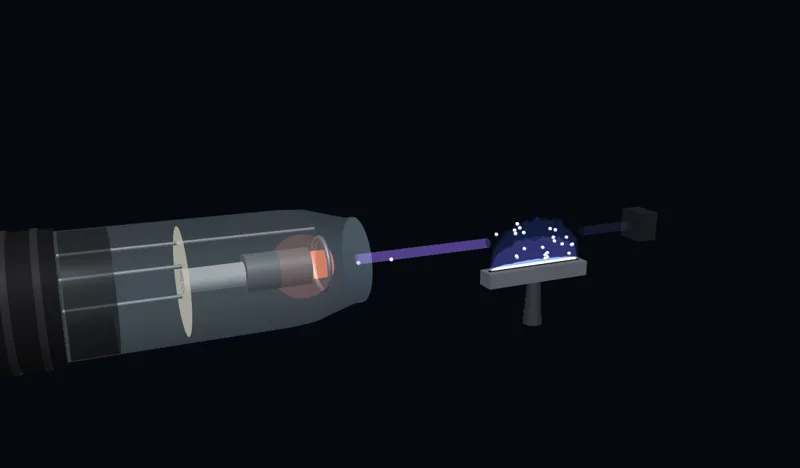
About this visualization
Seven parts: the instrument and its light path from the hollow-cathode lamp through a spinning chopper, the flame and the monochromator to the photomultiplier; inside a realistic hollow-cathode lamp, where neon ions sputter the cathode and you pick the lamp metal and the sample (Au, Fe, Na, Ca) to see that a lamp only works for its own element; from solution to atoms, following one droplet through the nebulizer and spray chamber into a real slot-burner flame; a cut-away graphite furnace running its dry, ash, atomize and clean programme; interferences, with ionization computed from the Saha equation, phosphate trapping calcium, and a vanadium line overlapping aluminium; background correction with a deuterium lamp and the Zeeman effect; and a practice bank. Lines are from NIST and flame data from Skoog’s Table 9-1. Key moments pause on the events that matter, and a History & Fun Facts drawer tells the stories of Alan Walsh, Boris L’vov and Pieter Zeeman.
Numbers come from NIST-JANAF thermochemical tables and are checked by program: Kp = 0.149 at 298 K, 4.49 at 350 K and 51 at 400 K, ΔH° = 57.1 kJ/mol, and Kc = 54.3 for H₂ + I₂ ⇌ 2HI at 430 °C. Slowed time and other simplifications are stated in the Guide.
Explore other chemistry visualizations on the HexaMole resources page.