
Interactive chemistry · Spectroscopy
Inductively Coupled Plasma
The fourth state of matter and how radio waves heat argon to 10,000 K: plasma with lightning, the ICP torch, the plasma zones, ICP-OES and ICP-MS.
Open Inductively Coupled Plasma ↗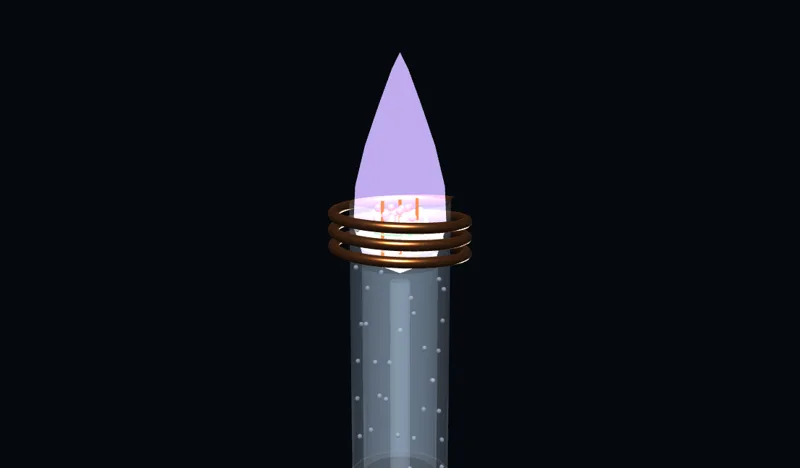
About this visualization
Seven parts: plasma, the fourth state of matter, as argon is heated from 10 K to 30,000 K through solid, liquid, gas and plasma, with lightning at 28,000 K and ionization from the Saha equation; the torch, where the coil’s field reverses millions of times a second, a spark seeds electrons, and the swinging electrons collide with argon until the plasma sustains itself; inside the plasma, with its temperature zones and a droplet’s journey up the central channel; why the ICP beats a flame, from the Boltzmann and Saha equations; an échelle spectrometer that records many elements at once; ICP-MS, with ions passing the cones into a quadrupole; and a practice bank. Key moments pause on the events that matter, and a History & Fun Facts drawer tells the stories of Crookes, Langmuir, Babat, Reed, Greenfield and Fassel, and Houk.
Numbers come from NIST-JANAF thermochemical tables and are checked by program: Kp = 0.149 at 298 K, 4.49 at 350 K and 51 at 400 K, ΔH° = 57.1 kJ/mol, and Kc = 54.3 for H₂ + I₂ ⇌ 2HI at 430 °C. Slowed time and other simplifications are stated in the Guide.
Explore other chemistry visualizations on the HexaMole resources page.